Web-Based Pump Performance Simulation and Analysis Tool
Introduction
Pumps are critical assets across industries such as water treatment, manufacturing, HVAC, chemical processing, and utilities. Ensuring optimal pump performance is essential for maintaining process efficiency, minimizing downtime, and preventing equipment failures.
However, engineers and maintenance teams often rely on spreadsheets, manual calculations, or fragmented records when evaluating pump performance. These methods can introduce computational errors, complicate tracking historical data, and limit the ability to analyze operational trends. We developed a Web-Based Pump Performance Simulation and Data Management Tool that enables engineers to perform accurate pump calculations, maintain structured pump data, and visualize performance trends through an intuitive browser-based interface.
Industry Challenge
In many industrial setups, effective monitoring of pump performance and management of pump data involve several operational challenges.:
Manual Calculations
Pump parameters such as head, flow rate, efficiency, and hydraulic power are often calculated manually or through spreadsheets, which increases the risk of calculation errors and inconsistent results.
Fragmented Data Storage
Pump configuration data and operating parameters are typically stored in multiple documents or local files, making it difficult for teams to maintain a centralized reference
Limited Accessibility
Engineering teams working across different departments or plant locations may struggle to access pump-related data in real time, which slows down troubleshooting and decision-making.
Lack of Performance Visualization
Without proper visualization tools, analyzing historical pump performance trends becomes difficult. Engineers often lack quick insights into operational deviations or efficiency changes over time.
These limitations can lead to delayed decision-making, inefficient pump operation, and challenges when performing comparative analysis across multiple pump assets.
Our Solution
To overcome these challenges, we designed and implemented a web-based engineering application that integrates pump performance calculations with structured data management and interactive visualization capabilities.
The system enables engineers to calculate key pump parameters using standard engineering formulas while maintaining centralized pump records accessible through a browser.
Key Capabilities
Centralized Pump Data Management
The application stores pump configuration data, pump types, and calculation history in a structured database, enabling engineers to quickly retrieve and reference pump information.
Engineering Formula-Based Calculations
Pump parameters are calculated using validated engineering formulas, providing reliable results for performance evaluation and analysis.
Pump Type Templates
Reusable pump-type templates allow engineers to standardize pump configurations across projects, ensuring consistent data entry and faster analysis.
Interactive Performance Visualization
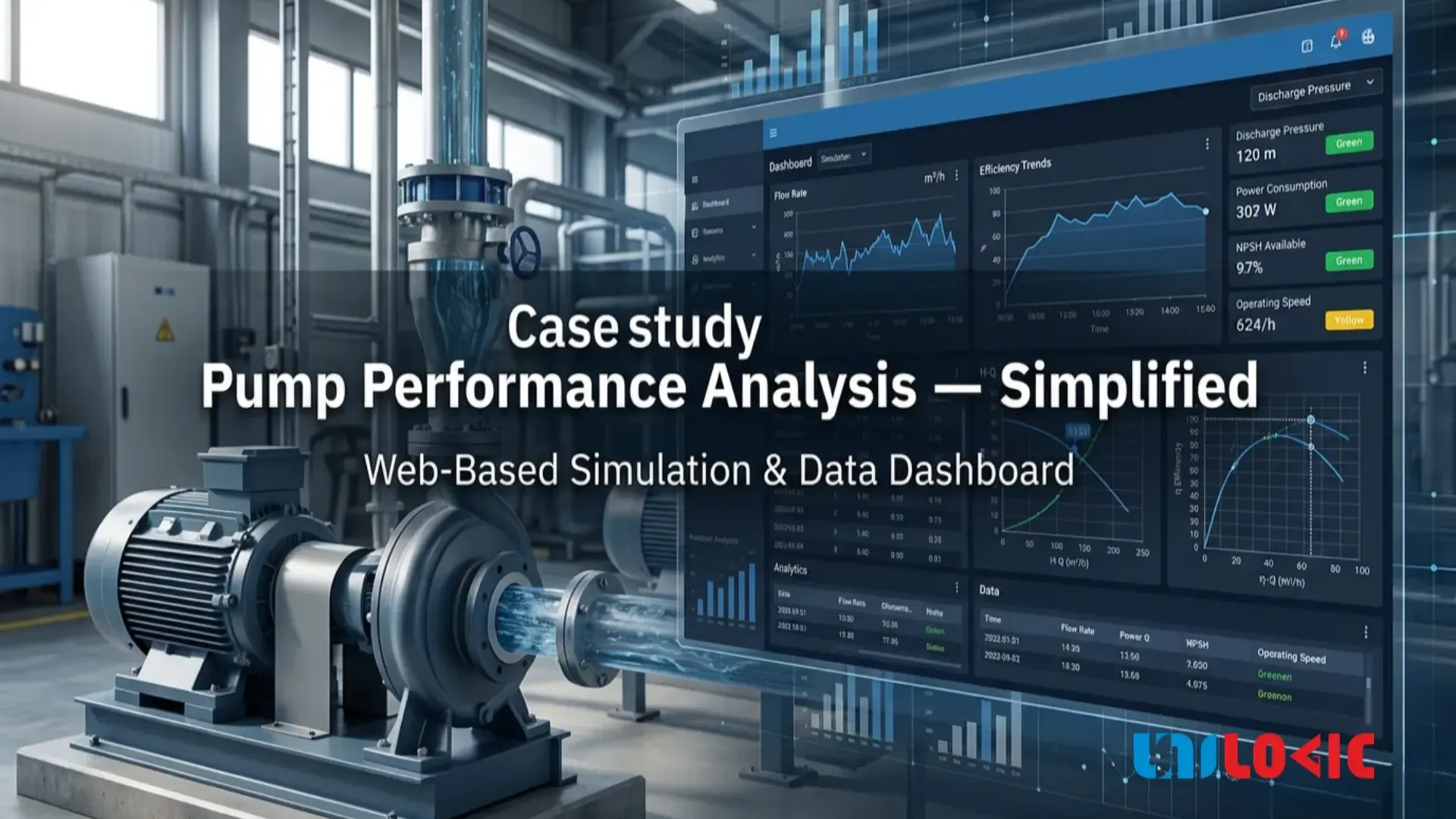
The system provides a graphical visualization of pump performance parameters, enabling engineers to analyze historical trends and compare operating conditions.
Web-Based Accessibility
Since the application runs in a web browser, engineers and maintenance teams can access the system from different locations without installing specialized software.
Pump Type Properties – Technical Configuration
The application allows engineers to define standardized pump configurations using configurable pump-type properties.
|
Property Name |
Description |
Example Values |
|
Pump Type Name |
User-defined classification of the pump |
Centrifugal, Vertical, Inline |
|
Pump Category |
Broad pump classification |
Dynamic / Positive Displacement |
|
Flow Range |
Designed operating flow limits |
20 – 200 m³/hr |
|
Head Range |
Designed pressure head limits |
10 – 80 m |
|
Rated Efficiency |
Nominal pump efficiency |
65% – 85% |
|
Speed |
Rated rotational speed |
1450 / 2900 RPM |
|
Fluid Type |
Fluid handled by the pump |
Water, Oil, Process Fluid |
These parameters help engineers maintain standardized pump specifications while performing calculations and comparisons.
Software Architecture
The system was designed with a modular architecture to ensure scalability and maintainability.
|
Layer |
Description |
|
Frontend |
Web-based interface for data entry, parameter calculation, and graphical visualization |
|
Backend |
Engineering formula computation engine and data-processing logic |
|
Data Storage |
Structured storage of pump master data and calculation history |
This architecture enables efficient separation of calculation logic, data management, and visualization components, allowing the application to be easily extended with additional engineering modules.
Key Engineering Benefits
The Pump Performance Simulation and Maintenance Tool provides several operational advantages:
Improved Engineering Accuracy
Formula-based calculations reduce manual errors and ensure consistent pump performance evaluation.
Faster Performance Analysis
Engineers can instantly calculate pump parameters and visualize results without relying on spreadsheets.
Centralized Pump Data
All pump configurations and calculation results are stored in a structured system for easy retrieval.
Improved Data Insights
Visualization of stored pump data helps engineers quickly understand performance variations across records.
Scalable Engineering Platform
The application can be expanded to include additional analytics, predictive maintenance modules, or integration with industrial monitoring systems.
Engineering Impact
By digitizing pump performance analysis and maintenance tracking, the system enables engineering teams to:
-
Reduce time spent on manual pump calculations
-
Maintain structured pump records across multiple assets
-
Enable real-time visualization of pump performance parameters using interactive graphical dashboards.
-
Support data-driven engineering analysis and reporting
The platform serves as a reliable engineering reference tool for pump performance evaluation and maintenance analysis.
Conclusion
The Web-Based Pump Calculation and Data Management Tool developed by Unilogic Technologies demonstrates how engineering calculations and structured data visualization can be effectively delivered through a modern web application.
By combining formula-based pump calculations, centralized data management, and graphical performance analysis, the system enables engineers to perform faster and more reliable pump evaluations.
Such digital engineering tools play an important role in improving data accessibility, engineering analysis, and operational decision-making across industrial environments.