BMS Functional & Calibration Tester
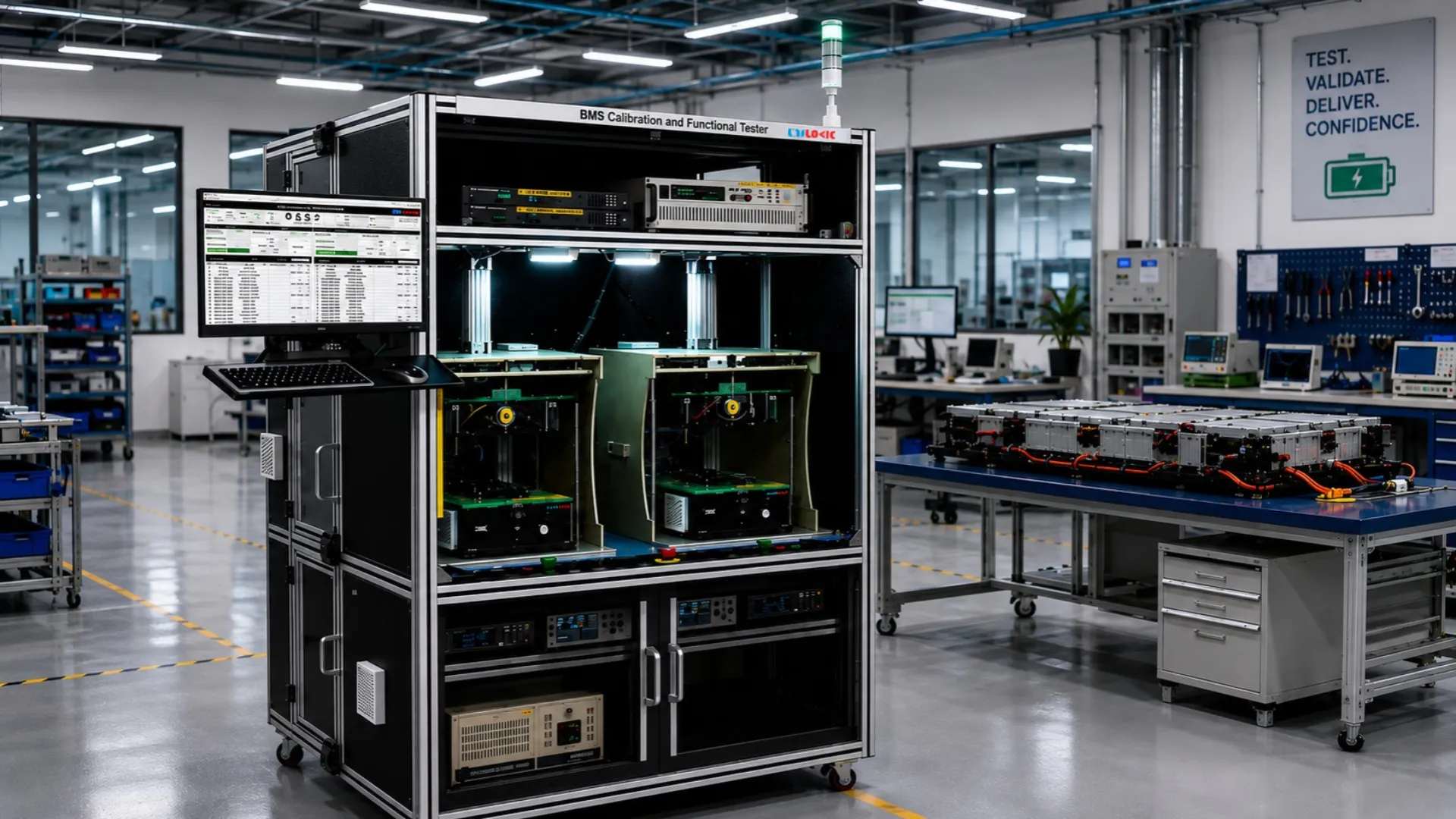
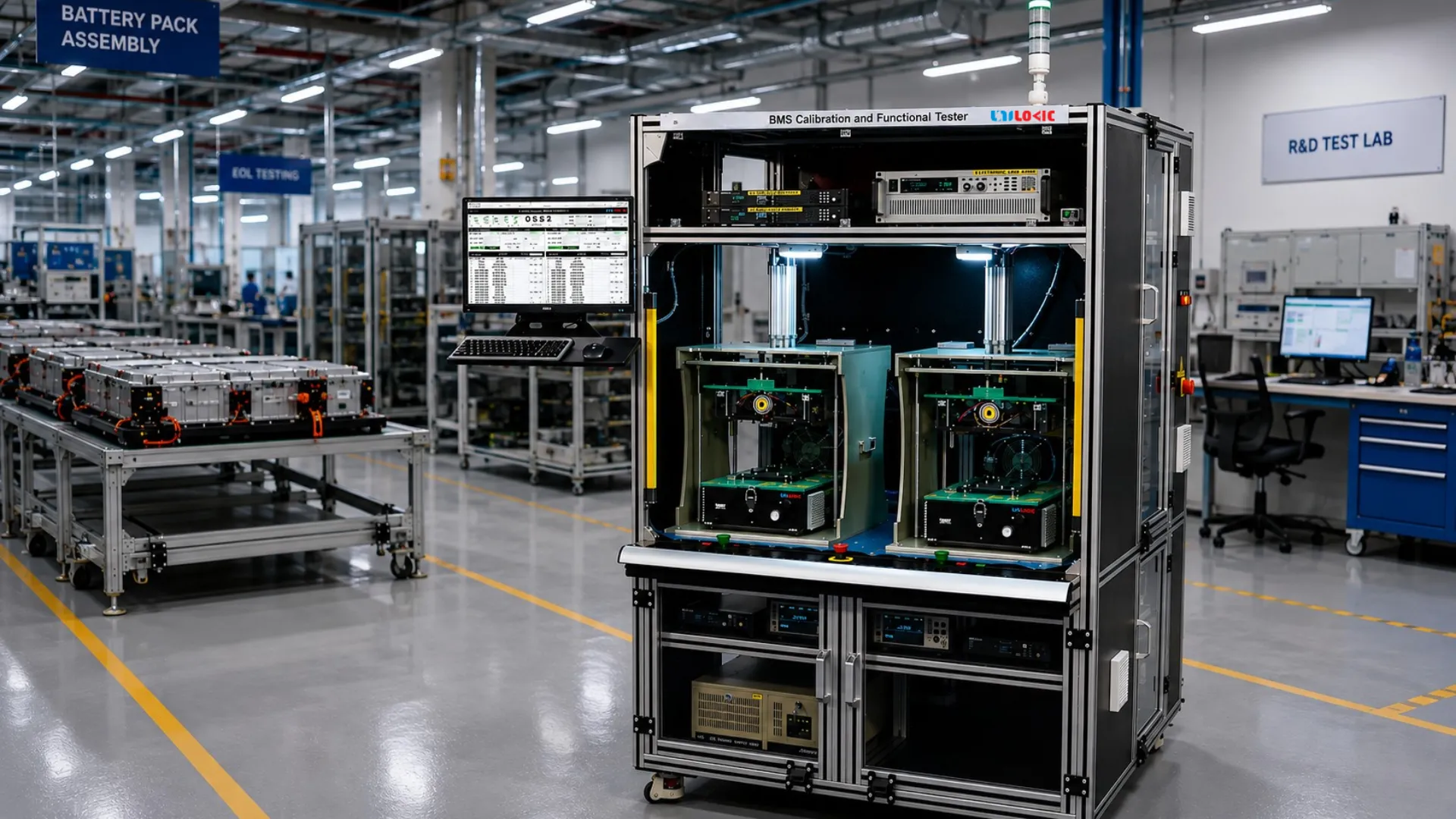
200A BMS Testing Platform with Parallel Calibration Capability
|
90-100 Sec |
200A |
5 |
Per-Unit |
|---|---|---|---|
|
Total Cycle Time |
Current Calibration |
Validation Domains |
Test Traceability |
Overview
Battery Management Systems play a critical role in monitoring and controlling battery performance, making reliable functional validation and calibration essential before vehicle integration.
For a leading EV manufacturer in India, Unilogic Technologies developed a BMS Functional & Calibration Tester with current calibration capability up to 200A, combining functional validation and parallel calibration within a single automated test platform.
The system brings five key validation areas into one test workflow: voltage, CAN communication, temperature sensing, cell balancing, and current calibration.
Built around NI LabVIEW, the platform automates instrument control, measurement, test sequencing, pass/fail evaluation, and test reporting, providing consistent validation and per-unit traceability.
The Challenge
BMS validation involves multiple test domains, including voltage, CAN communication, temperature sensing, cell balancing, and current calibration. Coordinating these activities requires multiple instruments, controlled test sequences, and consistent evaluation across different validation requirements.
Sequential calibration can also introduce wait states that add to the overall test cycle.
The challenge was to develop a unified testing approach that could execute these validation and calibration activities efficiently while maintaining consistent validation, traceability, and operator safety.
The Requirement
The test platform needed to provide:
- Current calibration up to 200A
- Five-domain BMS validation
- Parallel calibration capability
- Configurable test limits for different BMS variants and models
- Automated pass/fail evaluation
- Per-unit test reporting
- MES integration capability
- Hardware safety interlocks and isolated measurement channels
- A modular fixture architecture to support flexible model coverage and faster changeover
The Unilogic Solution
A Unified Platform for BMS Functional Testing and Calibration
Unilogic developed a 200A BMS Functional & Calibration Tester that combines functional validation and calibration within a single automated test platform.
The system is built around NI LabVIEW, which functions as the test sequencer and controls the connected instrumentation. NI-DAQmx driver integration supports real-time, multi-channel voltage, current, and temperature acquisition. Ethernet-based instrument control connects the DC Current Source, DC Electronic Load, and Programmable Power Supply.
The system executes test sequences, acquires measurements, evaluates results against configured limits, and generates automated test reports.
Instrument Integration
The platform integrates:
- DC Current Source for charge simulation and current calibration up to 200A
- DC Electronic Load for discharge simulation and load-side calibration from 100mA to 200A
- Programmable Power Supply for pack voltage excitation and cell-balance testing
- DAQ/DMM for multi-channel voltage, current, and temperature measurement
- CAN Interface Module for DBC-based BMS communication validation
Parallel Calibration
A key capability of the system is its parallel calibration workflow.
Parallel LabVIEW routines execute simultaneous calibration activities, reducing sequential wait states within the calibration process.
The automated test sequence achieves a total cycle time of approximately 90–100 seconds for overall test execution.
Five Validation Domains
The tester combines five key validation areas within the automated test sequence.
1. Voltage Validation
Multi-channel DAQ/DMM measurements are used to perform automated voltage sweeps and validate:
- Cell voltage
- Test-point voltage
- Over-voltage and under-voltage thresholds
2. CAN Communication
The CAN interface supports DBC-based message validation, including:
- Message ID
- DLC
- Frame timing
- Error frames
- Node response
3. Temperature Validation
Thermocouple and NTC channels are used with calibrated thermal reference simulation to validate:
- Cell temperature
- Pack temperature
- Ambient temperature
4. Cell Balance
Differential voltage injection and DAQ/DMM current measurement are used to validate:
- Passive balancing activation
- Balancing current
- Balancing threshold accuracy
5. Current Calibration
The DC Current Source and DC Electronic Load provide precision references for current calibration, with parallel LabVIEW routines supporting:
- Sensor offset calibration
- Gain accuracy
- Current calibration from -200A to +200A
Modular Bed-of-Nails Fixture
The tester incorporates a 90+ point Bed-of-Nails Fixture with a modular design for quick and easy model changeover.
The fixture features a universal cylinder alignment mechanism and a compact, portable structure designed for convenient handling during changeover.
Top Module
Test probes with integrated heat-sink technology support reliable electrical testing and thermal management.
Bottom Module
High-current probes are designed to withstand currents up to 250A, with an integrated storage section for test cables and small electrical circuits.
This modular architecture enables flexible model coverage, faster changeover, easier maintenance, and improved operator convenience.
How the System Works
The integrated platform takes the BMS through a structured automated test sequence.
1. DUT Connection
The BMS under test is connected to the test platform, with test results associated with the DUT serial number for per-unit traceability.
2. Test Configuration
The LabVIEW test sequencer uses configurable test limits for different BMS variants and models.
3. Functional Validation
The system executes the required validation checks across:
Voltage → CAN → Temperature → Cell Balance → Current
4. Parallel Calibration
Current calibration is performed using the DC Current Source and DC Electronic Load, with parallel LabVIEW routines reducing sequential wait states.
5. Automated Evaluation
An operator-guided front-panel UI provides clear Go/No-Go indication, helping reduce training time and human error.
Measured values are evaluated against configured limits, generating automated pass/fail decisions.
6. Reporting & Traceability
The system generates automated CSV test reports containing the DUT serial number, timestamps, and parameter-level results.
The traceable reports support warranty and field-return analysis. An export interface is also provided for MES integration and real-time production quality dashboards.
Technical Specifications
System Specifications
|
Parameter |
Specification |
|---|---|
|
Maximum Current Calibration |
200A |
|
Calibration Method |
Parallel calibration |
|
Validation Domains |
5 |
|
Software Platform |
NI LabVIEW |
|
Test Reporting |
Automated CSV reports |
|
Traceability |
DUT serial number, timestamps, parameter-level results |
|
MES Integration |
Export interface |
|
Safety |
Hardware interlocks and isolated measurement channels |
|
Fixture |
90+ point modular Bed-of-Nails Fixture |
|
Fixture High-Current Probe Capacity |
Up to 250A |
Instrument & Integration Architecture
|
Instrument |
Interface |
Primary Function |
|---|---|---|
|
DC Current Source |
Ethernet |
Charge simulation and current calibration up to 200A |
|
DC Electronic Load |
Ethernet |
Discharge simulation and load-side calibration from 100mA to 200A |
|
Programmable Power Supply |
Ethernet |
Pack voltage excitation and cell-balance testing |
|
DAQ/DMM |
Ethernet (NI-DAQmx driver) |
Multi-channel voltage, current and temperature measurement |
|
CAN Interface Module |
LabVIEW CAN API |
DBC-based CAN message transmission and reception validation |
|
NI LabVIEW |
Host PC |
Test sequencing, instrument control, measurement, calibration and pass/fail logic |
Results & Key Benefits
90–100 Second Total Cycle Time
The automated test sequence achieves a total cycle time of approximately 90–100 seconds for overall test execution.
Five Validation Domains in One Platform
Voltage, CAN communication, temperature, cell balance, and current calibration are integrated into a single automated test workflow.
Modular Fixture Architecture
The 90+ point modular Bed-of-Nails Fixture supports flexible model coverage and faster changeover, while its universal cylinder alignment mechanism and compact structure improve handling and maintenance.
High-Current Fixture Capability
The bottom fixture module incorporates high-current probes designed to withstand up to 250A, supporting high-current testing requirements.
Standardized Validation
The unified multi-domain test sequence standardizes validation and helps reduce variability in fault detection between test shifts.
Per-Unit Test Traceability
Each test result is associated with the DUT serial number, with timestamps and parameter-level results captured in the automated report.
Single-Operator Workflow
A single operator can run all five validation domains without requiring multiple test-station handoffs.
Automated Pass/Fail Evaluation
Configured test limits and automated evaluation logic provide standardized pass/fail decisions across the validation sequence.
MES Integration
An export interface supports MES integration and real-time production quality dashboards.
Enhanced Operator Safety
Hardware interlocks and isolated measurement channels support operator safety across the test platform.
200A Platform Capability
The 200A-rated platform is designed to accommodate current and next-generation battery pack designs without hardware changes.
Conclusion
The BMS Functional & Calibration Tester combines high-current calibration, automated functional validation, parallel calibration, modular fixturing, and traceable reporting within a single LabVIEW-based platform.
With support for 200A current calibration, five validation domains, a 90+ point modular Bed-of-Nails Fixture, automated pass/fail evaluation, per-unit reporting, and MES integration capability, the system provides an integrated approach to BMS testing and calibration for EV applications.
The modular fixture architecture further supports flexible model coverage, faster changeover, easier maintenance, and improved operator convenience.
The solution demonstrates Unilogic Technologies' capability to develop custom test and measurement systems that integrate hardware, software, automation, and data management into a unified testing platform.