NI TestStand vs Custom Orchestration – Field Guide for Industrial Test Systems
In modern validation and production environments, orchestration frameworks sit at the heart of test automation — coordinating DUT communication, instrumentation, data flow, and reporting.
Engineering teams often face a key question:
Should we standardize on NI TestStand or build our own orchestration layer?
Here’s a concise, experience-backed field guide to help you make that decision.
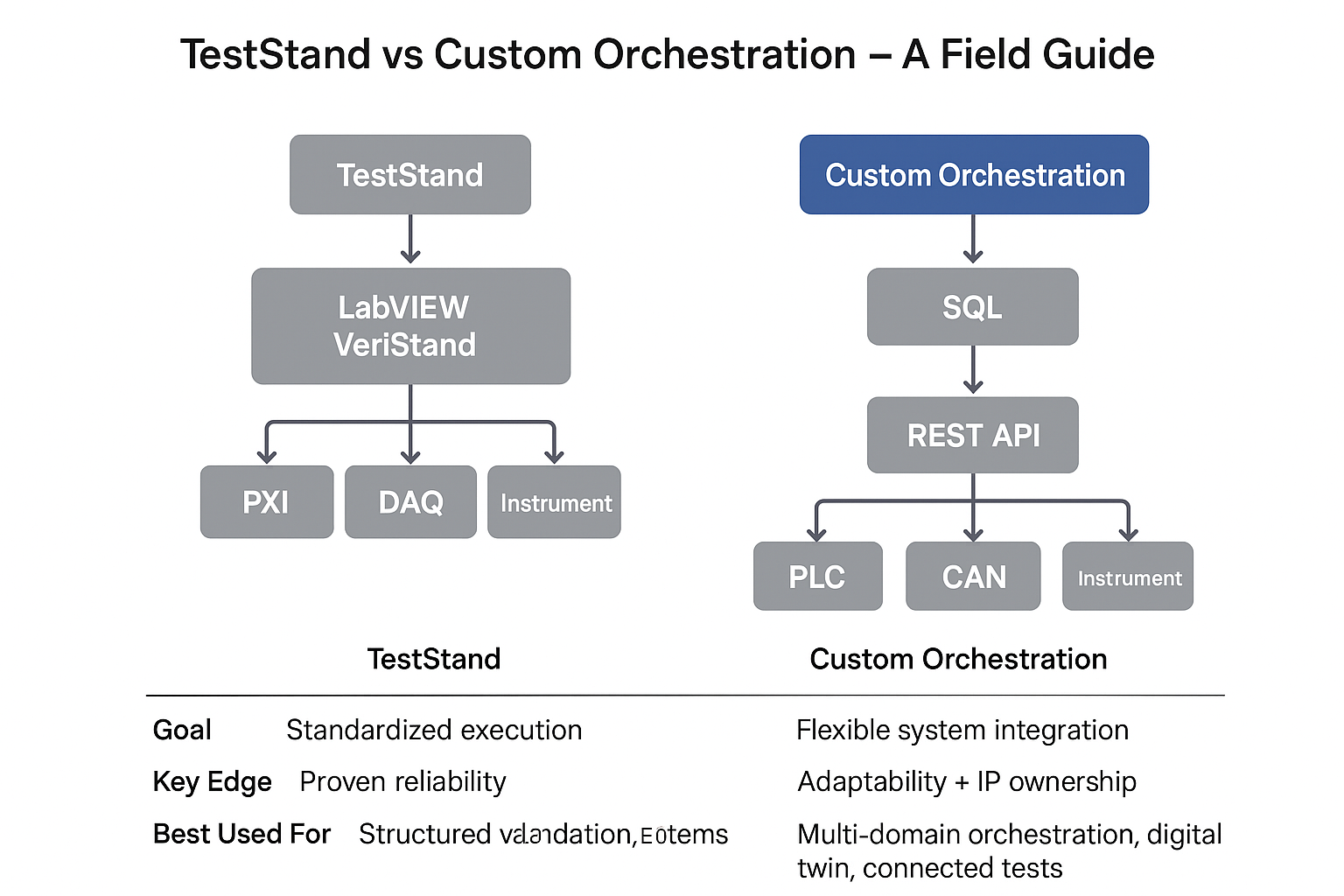
1. The Role of Orchestration in Industrial Automation
An orchestration layer defines how test sequences execute, how resources synchronize, and how data flows across multiple test benches.
Industrial test systems demand:
- Multi-station sequencing
- Hardware abstraction and code reuse
- Traceable data logging
- Integration with MES, PLM, or cloud analytics
- Robust error recovery and operator safety handling
Whether you use a commercial framework like TestStand or develop a custom orchestration system, these are non-negotiable pillars of a reliable industrial setup.
2. NI TestStand – The Standardized Test Execution Framework
NI TestStand is a production-grade test executive trusted across validation, HIL, and end-of-line systems worldwide.
Strengths
- Proven sequencing engine with built-in parallel test capabilities
- Tight integration with LabVIEW, VeriStand, and NI PXI/DAQ hardware
- Out-of-the-box support for operator interfaces, version control, and report generation
- Reduces engineering time with configuration over code
Limitations
- Licensing and deployment costs per station
- Limited flexibility for non-NI or cloud-native ecosystems
- Complex UI customization for unique workflows
Best Fit:
High-volume or regulated environments needing standardization, compliance, and traceability across test benches.
3. Custom Orchestration – Flexibility for Mixed Hardware and Web-Based Systems
A custom orchestration layer, often built using .NET Core, Python, or Node.js, allows full control over how tests, data, and infrastructure interact.
Strengths
- Platform-agnostic: integrates NI + third-party instruments, PLCs, or CAN networks
- Web and API-ready: connects to databases, dashboards, and cloud analytics
- Enables tailored UI/UX and business logic
- Offers complete IP ownership with no runtime licensing
Challenges
- Requires disciplined architecture for logging and modularity
- Higher initial development effort
- Validation overhead before production deployment
Best Fit:
When systems require mixed hardware, remote connectivity, or enterprise-level web integration.
4. Decision Matrix for Test Engineers
|
Criterion |
NI TestStand |
Custom Orchestration |
|---|---|---|
|
System Type |
Lab-based validation, EOL test rigs |
Distributed, connected test systems |
|
Integration Scope |
NI hardware, local instruments |
PLCs, CAN, REST APIs, databases |
|
Scalability |
Multi-station setups |
Cloud/web-based scalability |
|
Development Time |
Fast setup, minimal coding |
High initial effort, flexible structure |
|
Cost Model |
License-based |
Development investment, no runtime license |
|
UI & UX |
Standard operator interface |
Fully customizable, web dashboards |
|
Long-Term Control |
Vendor-driven |
Complete in-house control |
5. Unilogic’s Hybrid Orchestration Approach
At Unilogic Technologies, we apply a hybrid orchestration strategy that combines NI TestStand and custom frameworks for the best of both worlds.
Here find some implementations we did in our projects,
- Endurance Tester for Audio Amplifiers:
- Veristand - For configuring the hardware, handling data and custom devices.
- Teststand - For test steps sequencing.
- LabVIEW - For User Selection pop-ups and custom report generations..
- HVAC Functionality Tester:
- LabVIEW - For Data Acquisition and User Interface.
- Python - For developing Hardware drivers.
- MS SQL - For Data Maintenance.
Our Implementation Model
- TestStand + VeriStand Stack:
For HIL and endurance test benches, where deterministic sequencing and hardware integration are critical. - Custom Orchestration Frameworks:
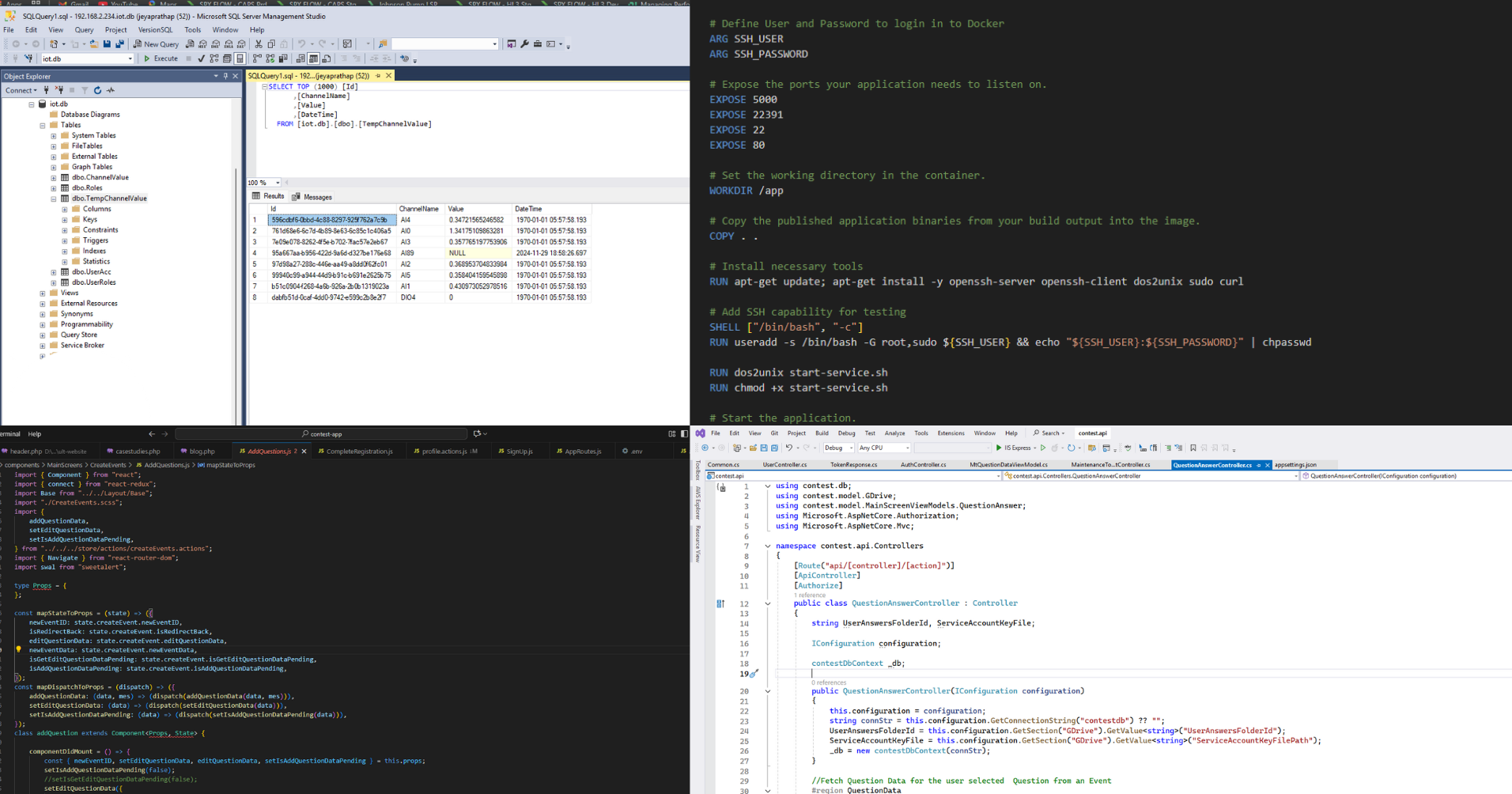
Built with .NET Core backend and React front-end, connected to SQL and REST APIs for dashboards, traceability, and remote monitoring. - Unified Layering:
TestStand executes the hardware sequences, while the custom orchestration layer manages scheduling, data storage, and supervisory control.
Key Advantages
- Plug-and-play test sequence expansion
- Centralized data and traceability
- Seamless scalability across lab and production floors
6. Summary – Choosing the Right Path
|
Feature |
NI TestStand |
Custom Orchestration |
|
Goal |
Standardized execution |
Flexible integration |
|
Key Edge |
Proven reliability |
Adaptability + IP ownership |
|
Best Used For |
Structured validation, EOL systems |
Multi-domain, digital twin, or connected systems |
Unilogic Technologies empowers engineering teams to build scalable, traceable, and integration-ready test automation systems using LabVIEW, TestStand, and custom orchestration frameworks.
Explore how Unilogic delivers hybrid test automation systems: Test Measurement Automation
Author: Kavinesh
Designation: Senior Project Engineer, Unilogic Technologies
FAQ's
1. TestStand integrate with non-NI instruments or software?
Yes, TestStand supports integration with third-party tools and software through ActiveX, .NET, and Python adapters, though deep customization may require additional engineering effort or hybrid orchestration strategies
2. What are the pros and cons of TestStand vs custom orchestration?
TestStand Pros: Ready-to-use sequencing engine, proven reliability, integration with NI hardware.
Cons: Licensing costs and limited flexibility for non-NI ecosystems.
Custom Orchestration Pros: Full control, no per-seat licensing, flexibility across technologies.
Cons: Requires higher development effort and disciplined architecture.
3. Why choose NI TestStand for industrial automation?
NI TestStand provides proven reliability, parallel test execution, and integration with NI PXI and DAQ systems—making it ideal for regulated and high-volume production environments where test standardization and traceability are critical.